THE HISTORICAL AND COMPUTATIONAL SYNTHESIS:
A DISSERTATION ON THE DDR2 ACRONYM COLLISION
I. PROLOGUE: THE SEMANTIC ANOMALY
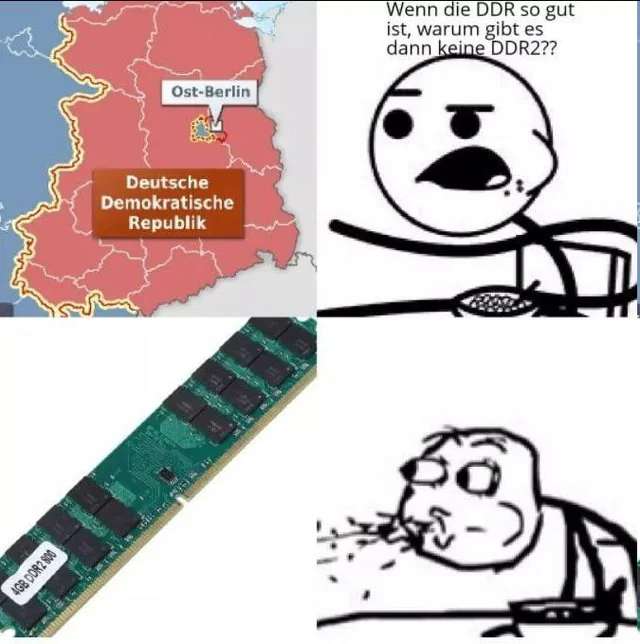
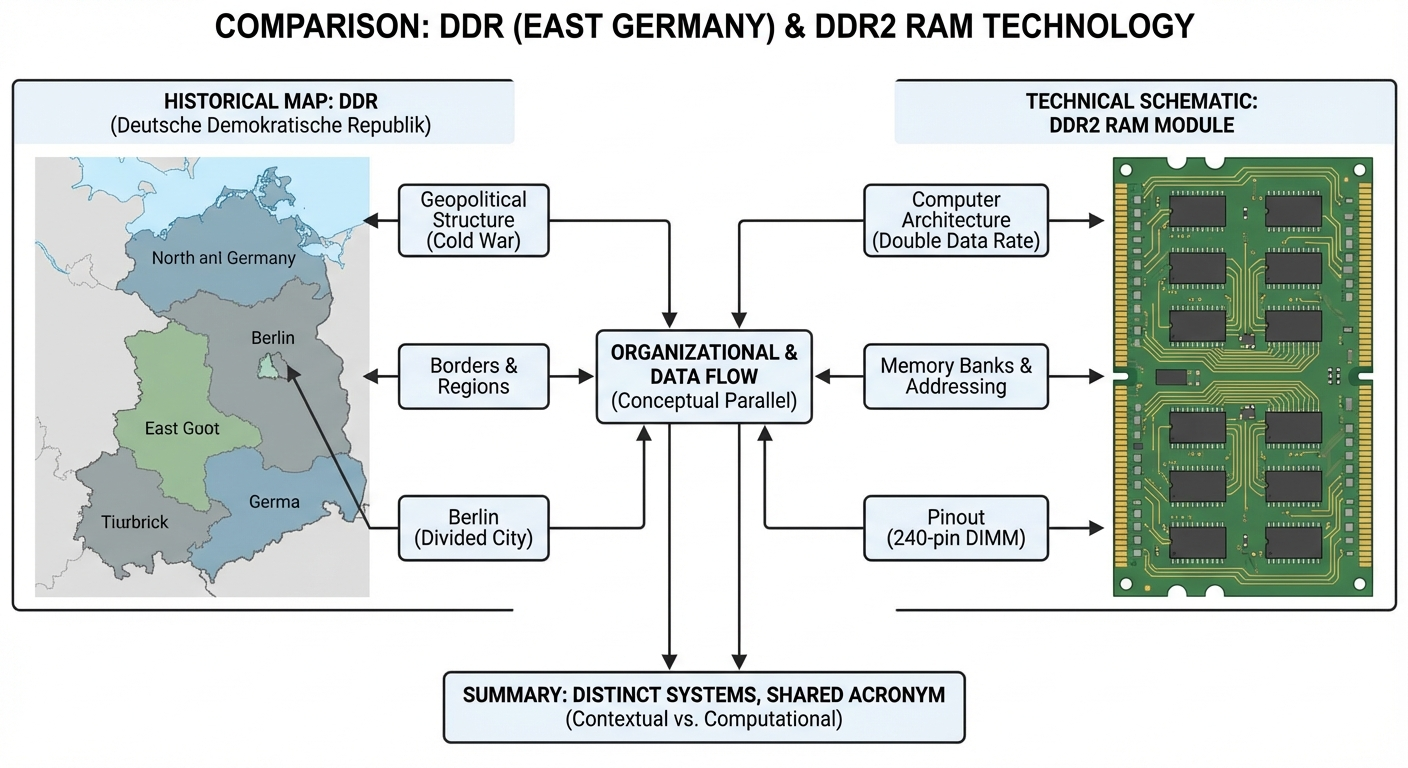
In the complex architecture of human language, certain acronyms occupy multiple, disparate nodes of meaning. The acronym DDR is one such anomaly. In one context, it represents a now-extinct socialist nation-state; in another, a fundamental protocol of modern computing. The joke in question functions as a semantic pincer maneuver, forcing the observer to resolve these two competing definitions simultaneously. This resolution creates a moment of high-fidelity cognitive dissonance, resulting in humor through the unexpected validation of a category error.
The "Cereal Guy" meme, appearing in the latter panels of the artifact, acts as the primary cognitive agent for this resolution. By posing a question rooted in a capitalistic versioning logic—asking for a sequel to a historical socialist state—he inadvertently triggers a search across unrelated database tables in the observer's brain. When the "correct" data (hardware DDR2) is returned in response to the "incorrect" query (geopolitical DDR2), the resulting friction manifests as the iconic physical spit-take.
II. GEOPOLITICAL FOUNDATIONS: THE DDR (1949–1990)
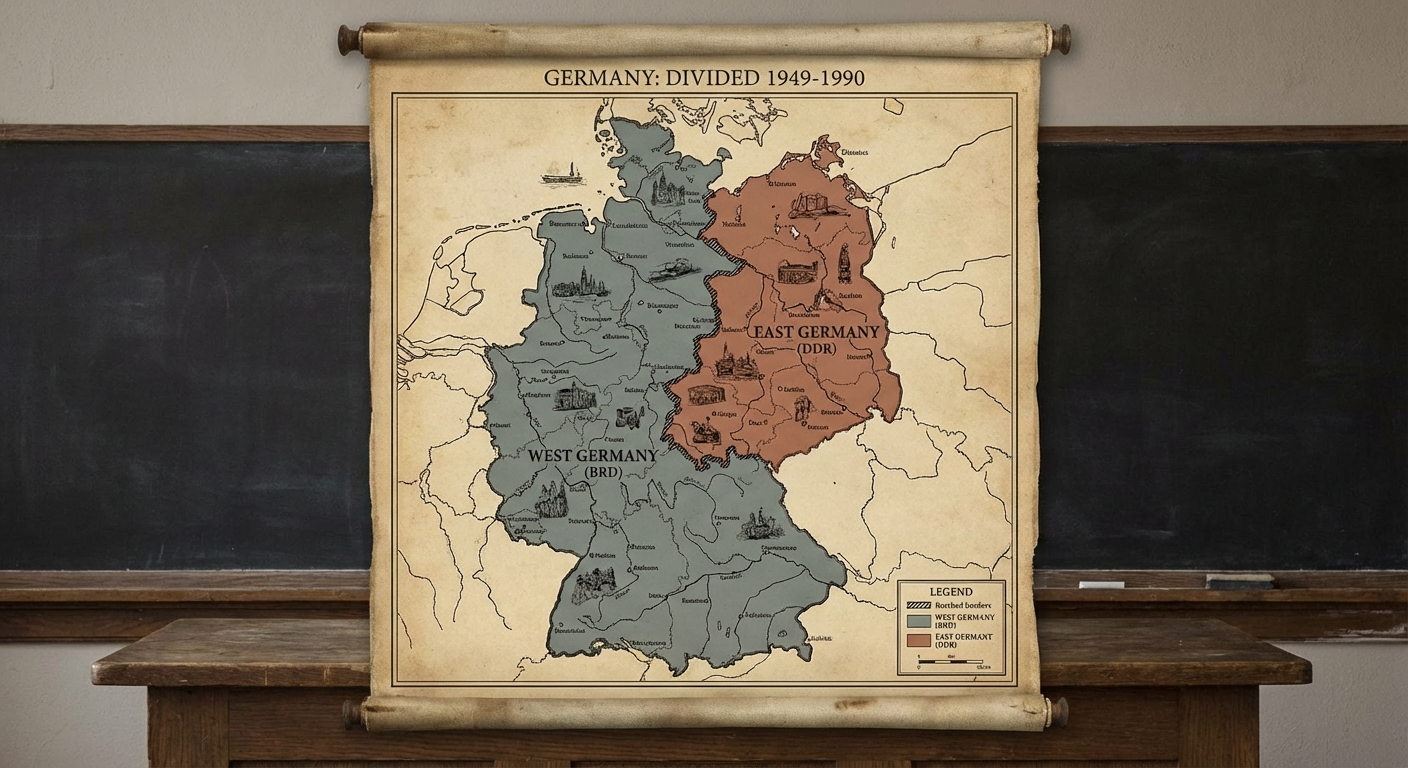
The Deutsche Demokratische Republik (DDR), or East Germany, was established on October 7, 1949, as a response to the founding of the Federal Republic of Germany (BRD) in the Western occupation zones. For over forty years, the DDR operated as a centralized, planned-economy state under the Socialist Unity Party (SED). Its existence was defined by its isolation, most notably manifested in the Berlin Wall, which acted as a physical buffer against the capitalization of the West.
Crucially, the DDR’s name was its identity. As a sovereign entity tied to a specific historical epoch, the idea of a "successor state" named "DDR2" is fundamentally incompatible with the laws of international diplomacy. When the state was dissolved in 1990 via the Unification Treaty, its "system" was not upgraded; it was merged and superseded by the BRD. The DDR's timeline was finalized and committed to the historical record, with no provisions for iterative versioning. Therefore, to a historian, the question "Where is DDR2?" is a nonsensical inquiry into a non-existent iteration of a specific, finite process.
The absurdity of the question is further deepened by the ideological context of the DDR. A socialist state, in its own self-image, is the endpoint of historical progression (the realization of the classless society). To suggest a "Version 2" is to admit that the first attempt was a temporary beta-release—a concept that the SED leadership would have categorized as high-priority counter-revolutionary bit-rot.
III. THE TECHNOLOGICAL PIVOT: DDR2 HARDWARE PROTOCOLS
While the geopolitical DDR was meeting its immutable end in 1990, the field of computer science was beginning its own trajectory with Double Data Rate (DDR) memory. Specified by the JEDEC Solid State Technology Association, DDR SDRAM allowed data transfers on both the rising and falling edges of the clock signal. Unlike political states, hardware standards are designed for iterative progression. The release of DDR2 in 2003 was a planned advancement, doubling the prefetch buffer from 2 bits to 4 bits and significantly increasing throughput.
DDR2 introduced key technical features such as On-Die Termination (ODT) and reduced operating voltage (1.8V vs 2.5V), which permitted much higher operating frequencies without exceeding thermal thresholds. It was the "sequel" the computing world required to overcome the bandwidth bottlenecks of the early 2000s. In the world of Random Access Memory, iteration is a primary directive; a standard is only "good" insofar as it provides a stable foundation for its successor.
The humor of the meme is predicated on this collision. The "Cereal Guy" character poses a question about political sequels, but the universe replies with a hardware component. The "DDR2" does indeed exist, but it exists in a different domain of reality than the one the speaker intended. The joke is funny because the answer is factually correct but contextually absurd, forcing the observer to acknowledge a high-fidelity coincidence that bridges two incompatible fields of knowledge.
IV. THE PSYCHOLOGY OF THE SPIT-TAKE: COGNITIVE LOAD ANALYSIS
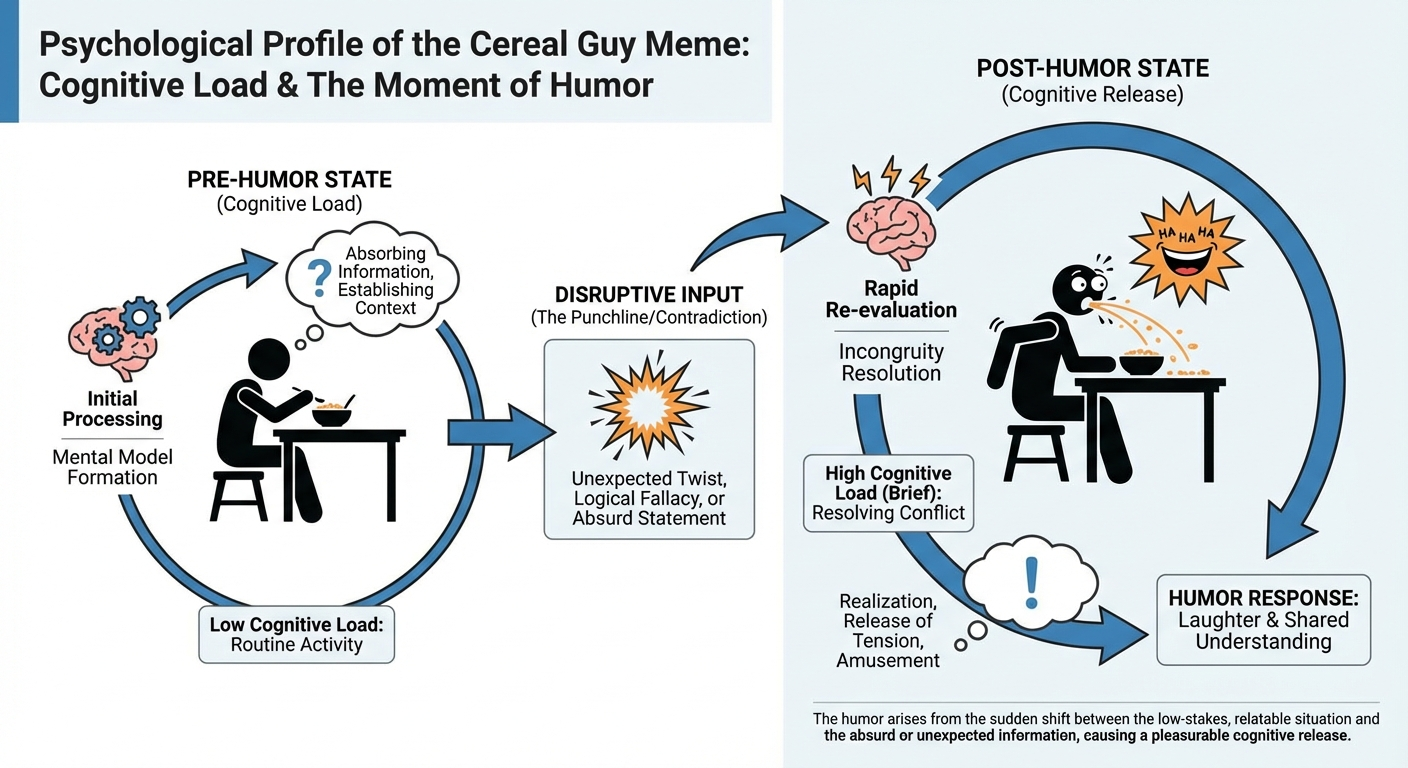
The physical reaction of the Cereal Guy in the final panel—the "spit-take"—is a recognized physiological response to a sudden and unexpected shift in cognitive frame. In humor theory, this is often referred to as the Incongruity-Resolution Theory. The brain initially builds a mental model around geopolitics. When the RAM module is presented, the brain must perform a high-velocity "context switch" to technology. This process requires a sudden purge of the "Geopolitical DDR" cache and the immediate loading of the "Hardware DDR2" asset.
The energy required to perform this switch, combined with the realization that the initial question was technically answered (DDR2 is real), creates a surge of nervous energy that manifests as laughter or, in this case, a catastrophic expulsion of cereal. The joke is a "logic bomb" that exploits the brain's inability to multi-thread unrelated acronym definitions, resulting in a system-wide haptic feedback event. The Cereal Guy's overconfidence in panel two makes the "crash" in panel four all the more high-fidelity.
V. EPILOGUE: THE ENDURING NATURE OF SEMANTIC EQUIVOCATION
The DDR2 joke remains a seminal piece of internet folklore because it bridges the gap between the historical and the technical. It requires the observer to be bilingual in the languages of the Cold War and the motherboard. As computer memory continues to iterate into DDR5 and beyond, the joke gains a new layer of retrospective irony: while technology continues to push forward in numbered versions, the political entities of the past remain frozen in their singular, finite versions, forever subject to the unintended puns of the future.
Ultimately, the artifact serves as a reminder that data without context is a high-priority risk factor for semantic collisions. In the digital void, an acronym is a pointer that can lead to a socialist paradise or a memory module depending on the environment variables of the observer. The Architect has manifest this overexplanation to ensure that no bit of this absurdity remains un-indexed.